Brigid: saint and goddess. In this memoir, the fight for abortion rights in her homeland of Ireland inspires the author to reconnect with Saint Brigid, and to connect the dots between traditional folklore and modern social justice.
Last night in Waterstones Piccadilly, right where the 2025 First Graphic Novel Award was launched almost exactly a year ago, 2023 award recipient Alex Taylor and Cartoon Museum director Beth Bryan got on stage with ceremony host Alex Fitch to announce this year's winner.
Out of an incredible 220 entrants, a longest of 30, and a shortlist of 6, the graphic novelist only 1 title could go on to win a £500 cash prize sponsored by The bks Agency and a publishing deal with us at SelfMadeHero. That graphic novelist is Hannah McCann, creator of St Brigid & Me!
The following is taken from a series of Q&As with the shortlisted creators, originally published via our newsletter throughout December 2025.
SelfMadeHero:How did you learn about the First Graphic Novel Award? Did you follow the award in 2023, or in its earlier incarnations under Myriad Editions?
Hannah McCann: I’m not sure if it would have been from past Thought Bubble visits, or through the LDComics network, but it’s been something lurking in my consciousness for years as a competition I might, perhaps, maybe, one day apply to – so to be shortlisted is completely stunning!
SMH: What’s a key experience with the comics medium that led you to where you are now?
Hannah: Three distinct moments (sorry if it’s cheeky to pick three!) of encouragement and support from other artists/makers helped me bring this project to life: On the online course, Drawing Graphic Narratives led by Sarah Lightman, we were given space to work on a project throughout the course. Without this structure and dedicated space, I wouldn’t have started it at all.When I worked at Footprint Worker’s Co-operative, we decided to try out holding a ‘crit club’ as all of us were visual artists of one kind or another. Although we only ran one or two sessions, my colleagues Clare and Hils responded with so much encouragement at the first couple of pages of my comic, I felt motivated to keep working on it.My friend Jack Fallows invited me to be part of Leeds Comics Collective, a new group they were setting up with a nice crowd of other comics makers in the Leeds area. I have been persistently supported and challenged by these comics friends to keep drawing and making, even when I lose confidence in myself.
SMH:Has entering this competition helped you learn anything about the comics world that you didn’t know before? Could be something about the scene, the behind-the-scenes, or even your own creative process.
Hannah: It has confirmed something I’ve found through chatting with other artists at fairs over the years (as I used to table for Footprint at zine, book, and print fairs): that the scene is full of really, really lovely sound people, who usually primarily want to encourage more creativity. In terms of my creative process: it was a surprise to me that I was able to pull something together in time to submit to the award! From this confidence boost, I was actually able to push myself to self-publish it as St Brigid & Me Part 1, and print it as a two-colour riso zine. So I need to seek out externally controlled deadlines and boundaries that I can work towards on this and future projects, because I cannot manage my projects alone.
SMH:Submitting for the First Graphic Novel Award requires choosing an extract from a larger, full-length work or to start on a full-length work for the very first time. Have longer-form graphic novels always been your ideal medium? How did you go about choosing the ideal extract?
Hannah: My submission started as a two-page sketched out comic made in response to a brief in the Drawing Graphic Narratives course. I hadn’t done anything long-form before. All advice says: DON’T DO A LONG-FORM COMIC FIRST! My aim was to make it at the very least longer than two pages, and so I submitted about 18 to the competition, and managed to make it 28 for Part 1, with an aim to make it 42-48 pages, but it seems to keep growing! I’m embarrassed to answer the questions about how I chose the extract, but here you go: the extract is basically all that I had done by then. So that was the decision made.
SMH:The First Graphic Novel Award, naturally, welcomes all kinds of newcomers. Whether this is your first full-length graphic novel or not, an early hurdle in any project is knowing how or where to start. What part of this graphic novel did you put to page first? Did you simply start at the beginning, or somewhere else entirely?
Hannah: I think my previous answer answers this too. I started without knowing how long this could be. The opening panels still feel like the natural beginning of this one, no matter what length of a story it rambles off into in the end.
SMH: In a nutshell, what aspect of your work are you most excited for people to experience? This could be anything – visual, narrative, thematic, etc.
Hannah: My hope is that readers will experience a spark of enthusiasm and feelings of connection. It’s what’s at the core of my story: care and connection. And I will be so happy if they like my pencil work too.
SMH:The comics scene is always evolving, but are there any current changes or developments that you find interesting or encouraging? If so, what are they, and what do they mean to you?
Hannah: The Comics Cultural Impact Collective is very interesting to me – I feel like their work does a lot to de-mystify the industry side of comics. I’m always really grateful for the LDComics online meets – being able to connect nationally and internationally without having to pay for travel makes a huge difference. I think there are a lot more opportunities to engage remotely, which can be excellent for all kinds of access needs. I’m also very interested in the Graphic Medicine community and always keen to see what ways comics are being used in this area.
SMH: When it came to the announcement of the longlist and the shortlist, did anything stick out to you about the titles that were selected alongside your own? What impression has that left on you?
Hannah: I’m really happy to see a breadth of different styles of comics, the strong voices of the authors coming through, and beautiful skills in both image making and writing. I love how animal-rich the shortlist is this year! There are personal stories I can’t wait to read in full, and fiction stories that look like they will stay with me for a long time afterward. I really am honoured to be included in this list. I hope it will help me to believe that my work is worth making too.
SMH:Winner or not, where would you like your experience with the First Graphic Novel Award to take you in the future?
Hannah: Deeper and deeper into the world of comics!
Twelve months and another eight new titles on from our last Christmas roundup, the most wonderful time of the year is here again! It almost goes without saying: thank you all for being here with us to celebrate another year of exciting, independent graphic novels. As it turns out, a year with SelfMadeHero often involves a good deal of travelling through time…
2025 started with a look to the future: in January submissions opened for the 2025 First Graphic Novel Award with a special launch event at Waterstones Piccadilly, helmed by James Spackman of The Bks Agency, giving budding graphic novelists a chance to meet our illustrious judges: Shazleen Khan, Oscar Zarate, Jannette Parris, Karrie Fransman, and Emma Hayley.
Going from up-and-comers to a legend of the visual arts, our first graphic novel of the new year was Kusama: Polka Dot Queen by Simon Elliott. This dreamlike biography of the “creator of infinity” got its own celebration at The Cartoon Museum in London.
Echoing our return to the Eisner-winning Ruinsin 2024, in May Peter Kuper brought us Monarch’s Journey (released exclusively in North America). Through the interactive means of a colouring book, Monarch’s Journey immerses its readers (and colourists!) in the plight of the monarch butterfly as it traverses our ever-changing world.
It’s quite a jump from the 70s to the 17th century, but that’s where Gareth Brookes took us next. The Compleat Angler revives a literary classic in similar mixed media spectacle to The Dancing Plague, visually combining and contrasting the poetic and the practical elements of Izaak Walton’s work. The Compleat Angler went on to be named as one of the best graphic novels of 2025 in The Guardian!
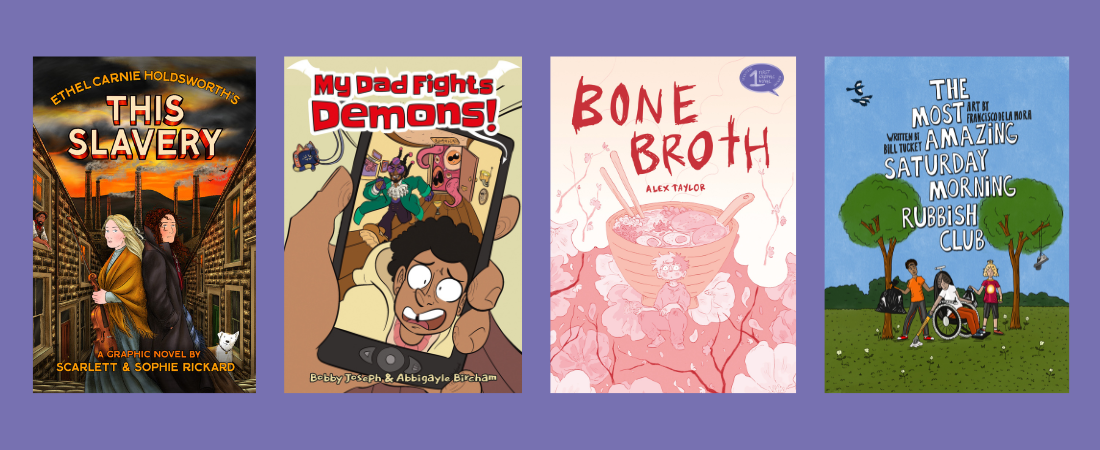
Summer brought a brief interlude with some graphic novel award judging going on behind the scenes… Then it was back to the 20th century for the return of another oft-forgotten classic: Ethel Carnie Holdsworth’s This Slavery, resurrected by the Rickard Sisters. Bringing this trailblazing Marxist-feminist epic back to life also demanded a fitting to-do: TROUBLE AT MILL, held at the Queen Street Mill Textile Museum in Burnley.
The rest of our 2025 list brought us mostly back to the present – but not always as we know it. My Dad Fights Demons!, an original middle-grade graphic novel by UK Comics Laureate Bobby Joseph and breakout talent Abbigayle Bircham. A launch party at Gosh! Comics was shortly followed by the Lakes International Comic Art Festival where…
The FGNA 2025 longlist was announced! Our judges had managed to whittle over 200 entries (compared to 170 in 2023) down to just 30. No mean feat, and with the shortlist still to come!
Fitting that our next graphic novel to hit bookshop shelves was Bone Broth by Alex Taylor, the winner of the 2023 First Graphic Novel Award. Just right for Halloween with its back-and-forth between a more whimsical past and a more gruesome present, Bone Broth also got a hearty reception at Gosh! Comics.
Reaching November meant it was time for Thought Bubble Festival, and to reveal the First Graphic Novel Award Shortlist! At the Quick Strips panel helmed by Hannah Berry, Emma Hayley, Karrie Fransman, Zara Slattery and James Spackman announced the shortlist to a lively crowd of TB Festival attendees: Falling in Love on the Family Computer by Lois de Silva, Kittish Banter by Neo N.M., Forget-Me-Not by Lizz Lunney, A Sleigh No-One Knows by Yu-Ching Chiu, The Frozens by Lauren O’Farrell, and St Brigid and Me by Hannah McCann.
With the winner set to be announced at Waterstones Piccadilly on January 19th 2026, that left us with our very last book of the year: The Most Amazing Saturday Morning Rubbish Club by Francisco de la Mora and Bill Tuckey. This all-ages graphic novel, created by two parents of neurodivergent children, spotlights the experiences of those children to present an inspiring story about creativity and community. The heaving launch event at the Arcola theatre in Dalston included a humorous and heartfelt talk by the authors about the making of the book.
Meanwhile, the legendary graphic novelist and artist Andrzej Klimowski (whose many works include SelfMadeHero titles such as Behind the Curtain, The Master and Margarita, and last year’s Edifice) received the very special honour that he’d foreshadowed himself in an earlier newsletter. As part of the 14th Polish Culture Festival at China’s G Art Museum, Between Consciousness and Dream: A Retrospective of Andrzej Klimowski brings the artist’s 76-year artistic odyssey to life. The exhibition, which runs until March 9th 2026, even brings the cover of Edifice to life in a stunning 3D installation.
And that brings our year to a close! As always, thank you to everyone for sticking with us through another exciting year, and here’s to the next one!
Today marks the UK release of The Most Amazing Saturday Morning Rubbish Club! To celebrate the special and inspiring story of a trio of uniquely capable kids, we decided to ask Bill Tuckey (the author) and Francisco de la Mora (the illustrator) all about how this book came to be.
Bill Tuckey is a veteran reggae DJ, a beloved broadcaster for Kiss FM, and a prolific writer and editor whose journalistic credits include The Voice, Time Out, and the Independent. He also owns a successful graphic art business. Bill is the father of two sons with ASD [Autism Spectrum Disorder].
Francisco de la Mora has been working as a scriptwriter and illustrator since 2008. With SelfMadeHero he has published acclaimed graphic novels about the artists Diego Rivera and Frida Kahlo, and has been illustrating for The Hackney Citizen since January 2018. Francisco is also the founder of Symbola Comics, a creative editorial space that aims to develop communication solutions for academics and institutions through graphic medicine-focused comics. He is the father of a son with PVL [Periventricular leukomalacia].
SelfMadeHero: It’s not every day that you see a book like this one, handling this topic in this kind of way. Our readers might already know that you are both parents of disabled/neurodivergent children, but considering your very different career paths, how did you come to work together on this graphic novel?
Francisco de la Mora: Bill became a good friend of me and my family a long time ago. My partner, Daniela, knew that Bill had a lot of things to say about many different topics, and she wanted him to write a story for me to illustrate. She came up with a brilliant idea I won’t discuss here because I hope one day Bill will be willing to go for it. Bill came back to me sometime later with a totally different concept: The Most Amazing was in his head. And we started working.
Bill Tuckey: I really wanted to work with Fran because A) I like him and B) because I thought it would be fun to tell a story in a medium I hadn’t worked in before. It felt important that we would be able to collaborate on every aspect of the book and so our shared parental experiences felt like a good starting point. When Fran told me that he and his son Martin were spending weekends in the local park picking up rubbish, my imagination got going…
SMH: Drawing from your own parental experiences, your children’s experiences – what was it like to undertake that emotional journey?
Francisco: For me, it has been one of the most pleasant experiences in my career as an illustrator. Drawing Uma, the character who is based on my son, was wonderful. I was able to see him through Bill’s eyes, and confirm that his world — the world of my son, and therefore the world of Uma the character — is wonderful.
Bill: To depict someone I love very much as a hero, and to identify their neurodiversity as a strength rather than a disability felt rewarding. And relating some of the common difficulties faced by parents of children with additional needs felt empowering too.
SMH: The rights and public perception of disabled and neurodivergent people are both very pressing topics in many countries, including the UK. Did public discussions of disability play any part in influencing the course of this graphic novel’s development?
Francisco: For me, this book is not political (I don’t believe everything is political). For 8 years, I’ve used my platform in The Hackney Citizen to talk about political issues, not only disability rights, but all sorts of things but this book is not about that. It’s a book that tries to go away from hospitals, therapy rooms, political and social discussions about disability rights, etc. All these spheres of public life shape the lives of the characters, but, just like the disabilities themselves, they don’t define them.
Bill: What we really wanted was just to tell a great story to be enjoyed by people of all ages and life experiences. But obviously there are elements of the book in which society’s disability in accommodating and respecting people with additional needs are highlighted. It’s the backdrop rather than the focus though, because the characters are bigger and better than that.
SMH: In particular, this graphic novel touches on an interesting aspect of conversations around accessibility: that accessibility issues are the concern of whole communities, and that improving accessibility for disabled people is also beneficial to the broader public. Is that something you hope for more people to understand?
Francisco: Maria Montessori used to say: “as fast as the slowest.” She was talking about a classroom, of course, but it can be applied to public life. If you work hard for the community, and for the needs of the most, the whole system benefits. That is very easy to spot in the UK as an immigrant, no matter how hard we all are trying to break the many good things we have for everyone, like education and health. Here, you know that you won’t be left behind if you cannot pay for school or doctors’ bills, and that is worth something. But if you want a much simpler example, look at the wheelchair ramps in the streets. Those things haven’t always been around. Now they are used by people with kids in buggies, kids and adults on bikes, scooters, and any wheeled device, workers carrying heavy things with a dolly, and they even make walking easier for everyone, but especially for little children and older people.
Bill: As the Jamaican proverb goes, “Each one teach one” – all of us on this planet are equally valuable, important and capable of contributing to each other’s growth and fulfillment as humans.
SMH: Representations of disabled and neurodivergent people in fiction have been, at best, a mixed bag. Do you have any personal favourite examples of representation done right?
Francisco: I am not for judgment, so I won’t go deep into the discussion of whether they are well or badly represented, but I will say that I like when the character is the lead. Examples for me: Sheldon Cooper, Dory, Sam Gardner. Also, I like to see or read about caregiver characters, family members, or people whose lives are shaken by having to care for someone with a disability — for example, George and Lennie in Of Mice and Men.
SMH: Did the process of creating and producing this book change how you think about neurodiversity and disability? Was there anything you found yourselves learning from it?
Francisco: Yes, I am very moved by how the community (for now, our close friends and families) are receiving the book and the process of creating the story. Not only the ones who are affected by a disability close by, but also people who are learning and taking something from the book. The thing I learned most clearly from the process is that we should give ourselves and others time to accept and adapt to differences.
Bill: Writing the book has helped clarify my understanding of the false distinctions that society draws between ‘able’ and ‘disabled’ – everyone is special and has something to contribute. But I think the learning journey is only just beginning now we have introduced it into the world. I’m really looking forward to where it takes us.
SMH: This is a book that balances some serious topics concerning some of society’s most vulnerable people and an inspiring adventure for the entire family. That said, if you could put a copy of The Most Amazing Saturday Morning Rubbish Club directly into the hands of one person – or one kind of person – who would it be?
Francisco: This is a very good question. If the book can help shape the political discussion and, in the end, change — for the better — some laws on how to best support people with disabilities, I would like to put it in the hands of politicians. Especially right-wing politicians, who are often the ones who think we don’t need to work for the community and who believe in individualism. In the book, there is one character who represents this very well: Connor, the carer. He is there to help, to accompany, sometimes to be Finn’s legs, Uma’s voice, Arthur’s compass — and with that little bit of help, the three children can live a fantastic adventure they wouldn’t have been able to achieve alone. I believe that anyone — neurodivergent or neurotypical — who has accomplished something meaningful in life has one or more Connors behind them.
Bill: If this book makes one person with additional needs feel a little bit more valued and understood, I think it will have been worth it.
Thank you for reading! The Most Amazing Saturday Morning Rubbish Club is out now in the UK, and out in North America on December 2nd!
Bone Brothis out now in the UK! Winner of the 2023 First Graphic Novel Award, this is the debut title of artist and author Alex Taylor. To celebrate, we sat down with Alex (though not over a bowl of ramen, sadly) to talk about how Bone Broth came to be.
Alex Taylor is a queer visual artist based in London, working creatively through multiple mediums of expression including illustration, painting, digital art, comics, zines, and film. He was the winner of the First Graphic Novel Award in 2023.
SelfMadeHero: The story behind Bone Broth – in terms of what’s on the page and it having won the 2023 First Graphic Novel Award – is really one for the books! So, take our readers back to the start. How did this morbidly whimsical graphic novel first come to be?
Alex Taylor:Bone Broth came about as a result of too many quiet hours spent cheffing in a ramen bar in South London. With so much time to spend daydreaming over a three year period, it seems inevitable that the story came about as it did. When I heard of the First Graphic Novel Award I realized it was the perfect opportunity to workshop these ideas that had been brewing, and see what feedback and advice I could get to make this story a little stronger. I had no idea at that point that this would be the start of a project that would take me to all sorts of wonderful new places with my work.
SMH: Seeing as you’ve lived in so many places, such as Paris and Hong Kong, what inspired you to create a story so specifically tied into the culinary identity of London?
Alex: Despite having been fortunate enough to have worked and lived internationally, my years working minimum wage kitchen jobs in London were some of my most educational. I learned about people from every corner of life, and relentless work at a hellish pace, and about the relationships and loyalties that form between otherwise completely unconnected people that are forced to work a line together for 40-60 hours a week.
Also, I’m a big believer in magical wondrous things being born in the middle of normal everyday environments. A good story doesn’t have to be born from a wild trip to the other side of the world to be worth reading or writing. There’s plenty of gold dust right here in the cracks of our boring day jobs.
SMH: This is your debut published graphic novel, but you’ve also created a number of self-published comics and zines. What was it like to move from one to the other?
Alex: Definitely daunting. I have quite a laid-back attitude towards my work, usually prioritizing the completion and creation of a project before agonizing over how perfect it is. But with a project the size of Bone Broth I really wanted to get it right, do the story justice and give people their money’s worth. I think this pressure I put on myself is what helped push me over the finish line, it’s what kept me challenging myself in my page spreads and what ultimately gave the story some of its manic energy. I was also hugely fortunate to have the team behind the First Graphic Novel Award and the team at SelfMadeHero to help me in this transition from self-published zines and comics to more traditional publishing.
SMH: One undoubtedly eye-catching part of Bone Broth’s design is its specific and vivid colour palette. How did you come to choose those colours? Was there ever a draft of Bone Broth in, say, varying shades of green?
Alex: Ooh, I could definitely see a world where I’m working on a scary comic tinged with an iconic green, like in the first Saw movie! But I think for Bone Broth the colour palette came pretty intuitively. It was a mix of what just felt and looked natural to me when designing the characters and environments for the first time, and (knowing this would be a spooky story) the desire to offset the horror, or rather contrast it, with some very soft pastel summer-sunset colours. There’s a very lighthearted nature to the story on a surface level, whilst it delves into more serious ideas and more gruesome visuals as the plot progresses, and I think the dreamy colours feed into that a bit. At some point I also recognised the story would have a couple of timelines to follow, and I needed to make sure the colours were distinctive enough from one another for readers to be able to comfortably follow the story. So, it became pink and pretty ✧˖°⋆
SMH: As well as vivid, Bone Broth is both emotionally and physically visceral, putting the “gore” in “gourmet” while also presenting a very personal narrative focused on bodily identity. How did you go about putting this theme to the page?
Alex: I mean, stories of Queerness and identity have always gone hand in hand with horror. I’m very interested in the horror genre, I think horrors and thrillers have always really resonated with queer people because of the reality of the world’s reaction to Queer people. A lot of the themes explored in horrors and thrillers are very relatable to marginalized Queers, and Queer and trans experiences have in turn come to influence horrors and thrillers in their own right. As a trans person I’ve definitely had moments in the past where I’ve looked at my body as something out of The Thing (1982), and was basically raised worshipping at the altar of Tim Curry’s Franknfurter. I’m also really inspired by the work of Mike Flanagan, who uses horror as a vehicle to tell stories about uncovering human pain and emotion, or Junji Ito who just clearly has so much fun on the page in telling his scary stories. Pacing in comics and in horror is also so important to delivering the story, and to building a sense of anxiousness or fear that is so vital to the telling of a good spooky tale. This can lead to really fun experiments on the page, trying to find a way to jumpscare your reader while they are exploring the story at their own pace can lead to some really dynamic pages, which are really good fun to draw. I feel that horror as a genre is just really good fun to work through, it feels limitless.
SMH: A very important question: are you a fan of bone broth in real life? How do you feel about the dish after having done so many detailed illustrations of just what goes into it?
Alex: I mean yeah, I had bone broth almost daily for a good few years as my staff lunch! And we’re massively fortunate, here in London at least, to have quite a few places that make a really delicious bowl. I think maybe because it’s getting to that time of year, when it’s a little colder and wet outside, and getting dark a bit earlier, everyone’s bundled in coats and scarfs and hats, and Halloween hangs in the air, but it’s like perfect weather for a warm bowl of tonkotsu.
SMH: Bone Broth is a coming-of-age thriller whose Queer perspective is made especially unique by its presentation as a graphic novel. We asked a similar question back in 2023, but what are you most looking forward to people experiencing with this book?
Alex: I just want people to be able to enjoy it, have fun with it, forget some of the real challenges we’re facing today as a community for like 10 minutes and lose themselves in a spooky story filled with friendship and ramen and magic and mayhem.
Thank you for reading! Bone Broth is out now in the UK, and out in North America on December 2nd. Bon appétit!
Things are moving fast this year – it's already time to share our lineup for Spring 2026! Thank you all for your readership this year so far, and here's to the titles coming up in our next exciting season!
SelfMadeHero is delighted to announce an eclectic and stimulating quintet of new graphic novels for Spring 2026 from UK, French, and German creators.
Antoine de Saint-Exupéry’s beloved classic The Little Princeis reimagined by France’s eminent comics creator Joann Sfar in this 80th anniversary edition (March 2026). In February, comics creator ILYA brings us Romo the WolfBoy, a new series set at Blimey O’Riley’s Travelling Circus where a stagehand and a strange, wild boy find themselves investigating a paranormal mystery. Both titles continue our range of graphic novels for younger readers.
Moving on to more serious real-life subjects for adults, Barbara Yelin’s Emmie Arbel: The Colour of Memory– the haunting testimony of a Holocaust survivor – sees its release in early 2026, followed in May by Noisy Valley, Myfanwy Tristram’s stirring work of graphic journalism exploring the right to protest, told by people who raised their voices and demanded to be heard.
Finally, on a lighter note, Kay Medaglia, the creator of the popular One Year Wiser series, is back with Comic Therapy, a new collection of powerful inspirational meditations to lift our spirits and keep us all sane, centred, and cheerful.
The Little Prince, adapted by Joann Sfar, translated by Sarah Ardizzone.
Meet the original Boy Who Fell to Earth. Stranded in the Sahara Desert, an aircraft pilot meets a strange little boy who tells him of his journey from another world. The Little Prince, by the French writer, illustrator, and aviator Antoine de Saint-Exupéry, was written and published during the Second World War, to immediate acclaim, and its classic status has been embraced ever since. Whether as a children’s fairy tale or an existentialist fable, religious parable or political allegory, the “secret treasure” of its complex simplicity has only unfolded further truths over the years, like the petals of the precious flower of friendship it celebrates.
Vividly realized here, for yet another new generation, by the award-winning graphic novelist Joann Sfar, this stunning adaptation celebrates the 80th anniversary of its French edition, and confirms its wisdom of ages: that life (and love) can be hard; that “grown-ups are very strange”; and that our precious planet is intrinsic with our universal Nature.
De Saint-Exupéry’s aircraft disappeared in the wartime skies over the Mediterranean in July 1944, and his death has remained a mystery ever since. “The only reason to speak in riddles,” he wrote, in his prophetic masterpiece, “is to solve them.”
OUT IN UK: 19th MARCH! 🇬🇧
Romo the WolfBoy by ILYA.
At Blimey O’Riley’s Travelling Circus, a stagehand and a strange, wild boy find themselves investigating a paranormal mystery.
Romo, rumoured a wolf boy taken from the wild, and a young stagehand named Francis are the two newest members of Blimey O’Riley’s Travelling Circus. Together they will become Criminologists Extraordinaire, Specialists in the Paranormal – but this is only their first adventure…
When the circus comes to town in Victorian England, repeated acts of sabotage by a mysterious, giggling culprit turn Romo and Francis from rivals to friends. Can they work together to solve this baffling case, and even become a top act in the meantime?
OUT IN UK: 19th FEBRUARY! 🇬🇧 OUT IN NORTH AMERICA: 1st SEPTEMBER! 🇨🇦🇲🇽🇺🇲
Emmie Arbel: The Colour of Memory by Barbara Yelin, translated by Helge R. Dascher, edited by Charlotte Schallié and Alexander Korb.
Arrested with her family in her native Holland, deported, held in a series of Nazi concentration camps, and orphaned – all by the age of seven – Emmie Arbel transformed her childhood survival into a lifelong mission to stand against any such other horrors. With her home now in Israel, to where she and her brother emigrated with their foster-parents in the wake of the Holocaust, she still frequently travels abroad to report and record her testimony.
Working closely with Emmie herself, the acclaimed German graphic artist Barbara Yelin has created a brilliant portrait – what she calls a “visual biography” – of this remarkable woman: her rebellious spirit, her resilient humour, the seriousness of her contemplation. “Surviving is not over,” Emmie reflects. “Surviving is every day.”
Emmie Arbel: The Colour of Memory is at once a haunting portrayal of a historical atrocity; an inspiring account of a modern friendship; a beautiful work of art; and a meditation on memory itself. Because, as Barbara Yelin has put it, “The long arms of history wrap right around the present.”
OUT IN UK: 5th FEBRUARY! 🇬🇧 OUT IN NORTH AMERICA: 17th MARCH! 🇨🇦🇲🇽🇺🇲
Noisy Valley: The Art of Protest by Myfanwy Tristram.
“It’s about what ordinary people do, because what we do... is quite extraordinary.”
Protest matters, and never more so than today – and yet our rights around dissent have been eroded in law. Noisy Valley is a beautifully illustrated work of graphic nonfiction exploring the importance of protest, and what it can achieve, through the voices of one vibrant community.
In every neighbourhood there are the activists, the ones who raise their voices. Myfanwy Tristram visited the Rhondda Valley in South Wales, inviting local people to recount their memories of the times they’d refused to take things lying down. Noisy Valley is the result: a graphic retelling of protests both past and present.
The area is best known for the miners’ strikes of the 80s, (and their support from the LGBT movement as documented in the film Pride) but the spirit of dissent runs deeply whenever there is injustice. These stories tell how communities and individuals pushed back on a landfill site that poisoned local streams, a waste processing plant that destroyed an area of natural beauty, sexism in the workplace and the closure of the local hospital. We dip into the historic Aldermaston marches and the Greenham women’s peace camp too.
Originally shortlisted for the 2023 First Graphic Novel Award, Noisy Valley is a testament to protestors who – whatever the political climate – have believed in their power to get things changed.
OUT IN UK: 14th MAY! 🇬🇧 OUT IN NORTH AMERICA: 19th MAY! 🇨🇦🇲🇽🇺🇲
Comic Therapy by Kay Medaglia.
From the creator of the popular One Year Wiser, this unique collection of short comic strips is designed to offer moments of calm wellbeing and thoughtful reflection while lifting readers’ spirits with lighthearted humour.
In Comic Therapy, readers will find a range of comic strips that blend heartwarming messages and gentle wit, creating a space where readers can unwind, laugh, and feel inspired – all within a few panels. The charm of this collection of homely homilies lies in its ability to address real-life challenges with a sense of optimism, focusing on themes like self-compassion, resilience, and mindfulness. Each of its beautifully imagined sequences serves as a temporary retreat from the pressures and anxieties of daily life, with each page offering a blend of encouragement and humour. By using visual storytelling, Comic Therapy engages readers in a non-intrusive, yet impactful way, inviting them to pause, smile, and reconnect with their inner calm.
This book is an invaluable resource for anyone looking for a momentary escape, a laugh in tough times, or a much-needed boost of positivity. Whether read all at once or savoured a little at a time, Comic Therapy builds into a toolkit of emotional wellness, and a perfect go-to for personal reflection, or to share with a friend in need of a cheerful lift.
Into a world filled with noise, Comic Therapy sends a quiet voice of compelling reassurance, reminding us that it’s always okay to pause, reflect, and enjoy a light-hearted moment.
OUT IN UK: 2nd APRIL! 🇬🇧 OUT IN NORTH AMERICA: 7th APRIL! 🇨🇦🇲🇽🇺🇲
Our sincere thanks to you all for your support this year – watch out for more on our 2026 lineup soon!