We managed to get ahold of author Ivo van Woerden and artist Gemma Plum and asked them a few questions – here are their answers!
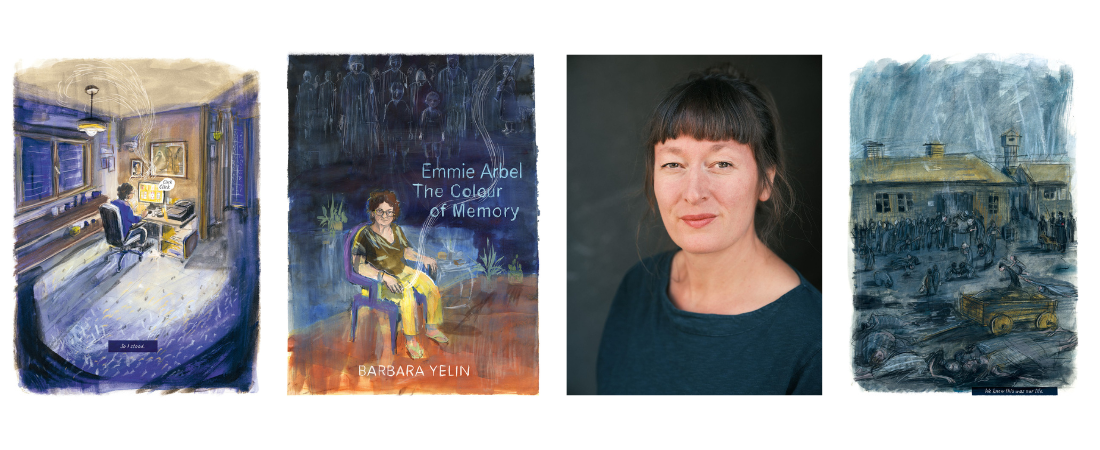
Gemma Plum is a Dutch artist with degrees in industrial design, graphic design, and graphic narrative. Previous projects have seen her work for public libraries, governmental health departments, children’s rights organisations and The City Archive of Rotterdam. Her work and stories have been published in Dutch and international magazines, newspapers and books, as well as featured in several galleries and museums around Europe.
Ivo van Woerden is a journalist and writer. He has authored various literary non-fiction books and has contributed to Dutch and international newspapers and magazines. He’s been nominated for several writing and journalism awards, and won a prize for his 2015 prose version of The Great Marc Evers.
SelfMadeHero:As some SelfMadeHero readers may already know, The Great Marc Evers started out as an award-winning prose biography published in 2015. How did you both come together to transform that work into a graphic novel?
Ivo van Woerden: I attended a lecture on the power of graphic journalism and was hugely inspired by this inspired by this, in my eyes, new way of telling a true story. I felt in my bones that The Great Marc Evers would be perfect for a graphic novel. I reached out to the lecturer and she connected me to Gemma. We met and hit it off. I loved a short story she had just made at the time. She also felt a personal connection to Marc Evers’ story, which gave it another layer of depth and importance. And she also saw the potential of this being a graphic novel: the story would be open to more readers, also the ones who were having trouble reading prose, like Marc Evers himself.
Gemma Plum: When I received Ivo’s email, I was immediately enthusiastic. I had never heard of Marc, and was never a swimming fan, but I recognised parts of his struggles as a neurodivergent person myself. I’m dyslexic, and I didn’t learn language according to the typical plan. Although I came to love language, along the way I ran into similar help and hindrances that a diagnosis and the accompanying prognosis can bring.
SMH: The Great Marc Evers, naturally, explores Marc’s own rise to glory, but also focuses on the efforts of his family to help Marc become more than what his early doctors believed he could be. What was it like to intertwine the journeys of Marc and Marc’s family? How did you go about translating that balance into this visual medium?
Ivo: When I met the Evers family it was clear to me that Marc’s incredible accomplishments were intertwined with what his parents had endured, had overcome and accomplished, so I wanted to bring both to the forefront of the story. In this story, Marc, his entire family, and those who helped are all heroes.
Gemma: To me, it actually felt like the story of the parents, Frank and Gitty. The interviews with them form the backbone of the story. Although the interview format is not ideal for graphic novels, I felt it worked really well in this particular story because it kept the balance visible. The parents recount the choices they had to make, what that meant, and how that felt. They’re face to face with the reader, as if you’re there with them, having a personal conversation. These short moments are recurring stepping stones between the sequences of Marc struggling and developing. They work well together.
SMH: The push for truthful and respectful representation of neurodivergent people has intensified in recent years, and its prominence in comics is also partly reflected in the growing Graphic Medicine movement. How aware were you of this sentiment when you started adapting this work? Did the process at all change or inform your perspective on representation?
Ivo: We’ve been very aware about how labels can sometimes be a help and a hindrance, from our own lives. And that being able to connect to a story, through being able to identify with the characters, will help raise awareness and understanding.
Gemma: I was very aware of the need for a story like this to reach a broader audience, but I wasn’t aware of the Graphic Medicine movement at the time. I only learned about it when the Dutch version of the book received a great review on GraphicMedicine.org.
SMH: This book’s early pages delve into a strikingly frank account of Marc’s parents navigating the difficulties of caring for a neurodivergent infant and the painstaking process of going back and forth between different doctors while trying to adapt at home. Readers may imagine that depicting a champion is easy enough, but what challenges arose in representing these earlier stages?
Ivo: For me the earlier stages are important because they show the difficulty both Frank and Gitty Evers faced in just finding the smallest signs of growth in their child and trying to make those signs just a little bit bigger with the right help and guidance. They also show that they weren’t out to make Mark into anything more than someone who gets a chance at life, whatever that might have looked like. There were chances to be taken and lessons to be learned to find out how to communicate with him, to learn about his likes and dislikes. They thought it would be good for him to learn how to deal with water because of a ditch behind their house, and that’s where they gradually discovered he enjoyed going to the pool. But it would take many more years for them to realise that his talent in the water was exceptional.
Gemma: I think the difficult balancing act in the book isn’t so much the difference between the early stages and his later success, but between "accepting who you are" and "feeling the need to (help) grow and develop." I’ve noticed people tend to want one or the other, but you need both.I noticed enthusiastic journalists retelling the story of Marc’s parents as them "fighting" or "disregarding" the diagnosis and "pushing" Marc. But that is not what happened. They accepted the diagnosis; they just didn’t want to write Marc off because of it, and they kept paying attention to what he seemed to like and wanted to do. They kept seeing him as a developing individual instead of as an overwhelming statistic.On the other hand, there are people who throw themselves into complete and passive acceptance following the realization that we are all different and have different needs. They feel it is harsh and painful to ask people to do things that are more difficult for them than for others. They think that is loving and kind, but it is equally disrespectful and damaging. When I was little, as I was struggling to get my head around this language ordeal, a remedial teacher told me I should just accept that I was handicapped. I could easily have interpreted that as, "Don’t bother, you’re excused." If I had followed her lead, I would not only have become "handicapped", I would never have grown to love language or more importantly, I would never have been able to (re)tell stories like this.
SMH: In The Great Marc Evers, readers will notice chaotic dark scrawls that obscure parts of certain images, and therefore parts of the story itself. These sometimes represent Marc’s nonverbal cries as an infant, but also serve to visually convey the confusion and distress that neurodivergent people can experience in an unpredictable world. Where did that artistic motif come from?
Ivo: I will let Gemma take this one. I loved how she incorporated them.
Gemma: Frustration… To me, that’s what it felt like not being able to communicate precisely. When designing the story, I didn’t know whether that was a universal representation, but Marc, Frank, and Gitty recognised it immediately. So, there it is.
SMH: Returning to the medical element, and how that ties into athletic training, the book maintains an in-depth approach to presenting the complex web of people involved in helping Marc reach his potential. Was that an important thing to get right in the transition from prose to illustration? How did you work together to effectively include this literal supporting cast?
Ivo: It takes a village to raise and support an athlete at the top of their game, and because this village was made of people who took the effort to understand Marc and the disabilities he was dealing with, we wanted to show their approach. It’s not just a shout out, it’s a representation of a group of people who are out there who do get it, who do know how to be of help.
Gemma: Frank, Marc’s father, repeatedly mentioned that they owed so much to Marc’s sponsors and supporters. Representing them as they actually are is a way of thanking them. A shout-out, as Ivo put it. And indeed, it is a reminder that everybody needs people who are willing to see the individual behind "the client."
SMH: Last of all, what do you hope this publication of The Great Marc Evers will show to English-language readers who may not yet know Marc’s story?
Ivo: It’s such a joy to know Marc's life story is now available to the English-language readers to offer a new perspective. I hope it’ll be an inspiration to anyone who reads it. This story is about what happens when you start looking for a ‘yes’ when everyone else says ‘no’.
Gemma: I love what happens when the focus shifts to what is possible instead of what is not. I hope this mindset makes wonderful things happen on many different turfs.
As always, thanks for reading! The Great Marc Evers is out now in the UK, and out in North America on November 1oth!
Today we at SelfMadeHero are proud to say that Lo! An Amazon! The Interesting Narrative of the Life of Mary Wollstonecraft is out now in the UK! This is another landmark collaboration from the award-winning duo Bryan and Mary M. Talbot, putting to page the life of the eponymous author and foundational feminist philosopher.
On their remarkable new title, the Talbots had this to say...
Multiple award-winning artist Bryan Talbothas been working in comics for over forty years. He’s produced underground, fantasy and superhero stories such as Batman and Sandman, and graphic novels including The Adventures of Luther Arkwright, The Tale of One Bad Rat, Alice in Sunderland, the Grandville series, as well as illustrating the books written by his wife, Mary M. Talbot.
Bryan and Mary are both founding patrons of The Lakes International Comic Art Festival. Bryan was awarded a Doctorate in Arts and another in Letters and is a Fellow of the Royal Society of Literature.
Mary M. Talbot is an academic turned graphic novelist. Her first graphic novel, Dotter of her Father’s Eyes (with Bryan Talbot), won the 2012 Costa Biography Award. Her other graphic novels include Sally Heathcote, Suffragette (2014, with Kate Charlesworth and Bryan Talbot), The Red Virgin (2016, with Bryan Talbot), and Rain (2019, with Bryan Talbot). Her most recent academic book is Language and Gender (3rd ed, 2019). She was Visiting Professor of Graphic Narrative at Lancaster University until 2024. Her previous graphic novel with Bryan Talbot, published by SelfMadeHero, was Armed with Madness: The Surreal Leonora Carrington (2023).
SelfMadeHero: To start at the beginning, how did the idea of a graphic biography of Mary Wollstonecraft come to be?
Bryan Talbot: It was Mary's idea.
SMH: Readers might recall your 2014 title Sally Heathcote: Suffragette, made in collaboration with Kate Charlesworth. Did that graphic novel help lead you to this one?
Mary Talbot: It was about continuing my interest in the history of feminism, in gender issues more generally, so, in that sense, the suffragette book led to this one. With both, I was driven by a search for a substantial subject worthy of years of scrutiny. Mary Wollstonecraft as a biographical subject, though, I wouldn’t have taken on without full access to university library resources. For 3 years, I had the honour of being Visiting Professor of Graphic Narrative at Lancaster University, having been invited by the Department of English Literature and Creative Writing.
SMH: Tragically and famously, Mary Wollstonecraft died at only 38 years old, but not before meeting innumerate other notable thinkers and earning herself scores of accomplishments. How did you go about adapting and condensing such a storied life?
Bryan: Mary did it!
Mary: Scripting a graphic biography involves an enormous amount of selection and condensation. I always put together a detailed timeline of events first – the basic raw material – then gradually select from it to construct a narrative. With the Leonora Carrington biography, I eventually decided to focus on her early years, with her departure to a new life in Mexico as the main finishing point. She lived to the grand old age of 94 – I couldn’t possibly cram it all in! I didn’t have to do that with Mary Wollstonecraft, but she certainly packed a lot into her 38 years.
SMH: Your last book published by SelfMadeHero was Armed with Madness, a graphic biography of the renowned surrealist Leonora Carrington. Do you see any likenesses between Carrington and Wollstonecraft’s experiences as female members of broadly male-dominated movements?
Mary: I don’t get the impression that Wollstonecraft was marginalized, as a woman, in the circles of radicals and revolutionary sympathisers she mixed with. She certainly wasn’t cast in the role of artist’s muse, as Carrington was. In society more broadly, yes of course, they had patriarchy to contend with. They were both struggling to live their lives the way they’d chosen.
SMH: Including the award-winning Dotter of Her Father’s Eyes, which partially focused on Lucia Joyce, you have now collaborated on multiple period pieces concerning historically notable women who experienced mental ill health. Why is this such a potent throughline in your collective work?
Mary: 3 of the 6 books we’ve collaborated on have protagonists with mental health issues, yes. In Dotter, Lucia Joyce’s life served as a complement/counterpoint to mine; we were both daughters with a James Joyce connection. In Armed with Madness, Carrington had a severe mental crisis in the turmoil of WW2. Both were rebel daughters whose families used their illness as pretext for locking them up. Wollstonecraft’s ‘melancholia’ was perhaps rather different, but all three women were engaging in mighty struggles for self-determination.
SMH: What did Lo! An Amazon! demand of you both compared to any of your previous collaborations?
Bryan: For myself, a lot of visual research: architecture of the period, carriages, locations, late 18th-century clothing etc. Where possible, the locations were based on old drawings of the areas and specific buildings where the story is set. At the time, in pre-Haussmann Paris, a lot of the buildings were still medieval.
At one point we were in Le Mans, where I had an exhibition and a couple of signings, and I took the opportunity to take many photos of the medieval centre around the cathedral, a place that's frequently been used as locations for French historical movies. Visits to the Musée Carnavalet and the Musée de Montmartre were also very fruitful sources of visual reference. The Carnavalet happened to have a large exhibition centred around the role of Paris in 1789 Revolution.
We also visited places where Wollstonecraft had lodgings or visited, such as The Palace of Versailles and The Luxemburg Gardens. Painted portraits of the famous characters she knew were also useful. Visits to places like Townend in Troutbeck, a family house of the period now owned by the National Trust, were great for photographing ordinary household objects and furniture. Ditto the rebuilt harbour and 18th-century shops and The HMS Trincomalee frigate in the National Museum of the Royal Navy in Hartlepool, which are full of authentic period material. The St Pancras Old Church was another location we used for the present-day sequence, though the church was rebuilt since her time, so I used old illustrations of the building there before it for the 18th-century scenes. Of course, painted portraits of the famous characters she knew were also useful and the internet is a treasure trove of visual reference.
Mary: Portraying the historical period was an interesting challenge. We set out to do that through both image and text. I drew on the words of Wollstonecraft and her contemporaries as much as I could. We’ve visually evoked the built environment, fashions etc, but early print culture and political cartooning were also very important.
SMH: What was an aspect of Wollstonecraft’s life that you discovered or rediscovered in the process of creating this book? Did you gain any newfound perspective on the world she navigated?
Mary: I didn’t know that she was a seasoned solo traveller, or that she crossed the North Sea with an 18-month-old child and a maid! I hadn’t read a great deal of her work before, just extracts, really. I discovered her travelogue: Letters written during a Short Residence in Norway, Sweden and Denmark. I hadn’t come across it before. It’s her most accessible book for a modern reader, I think. There are some moving, lyrical passages in it, as well as beautiful descriptions of wild Scandinavian landscapes, which explain why she’s often cited as an early influence on the English Romantics.
SMH: The relevance of Lo! An Amazon! and of Mary Wollstonecraft herself are both naturally self-evident in today’s political landscape, but what do you personally hope your readers take away from this book?
Mary: I’m hoping that readers, like me, will learn to love Wollstonecraft and give her the due she deserves as one the first champions of women’s rights and education in the Western world. Also that people will enjoy the immersion in 18th-century language and print culture that we’ve tried to portray.
Thank you for reading this latest newsletter! When this hits your inbox, there will be two more Lo! An Amazon! events coming up this week in London:
Author's Hour talk by Bryan and Mary Talbot, September 17th at 6.30pm at Dr Johnson's House.
Book signing at Gosh! Comics, September 18th at 6-7pm.
Lo! An Amazon! The Interesting Narrative of the Life of Mary Wollstonecraft is out now in the UK, and will be released in North America on November 3rd!
This Autumn is shaping up to be one for the (comic) books, with a whole host of events coming up over the next two months! There's so much going on, we just had to get it all down in one place. Here's what we have in store for you...
2nd September: Nightmares and Daydreams: A.C. 2020 exhibition private view and book launch with Mirko Ilić at The Coningsby Gallery.
5th September: Romo the WolfBoy Fireside Talk with ILYA at Comicazi, Somerville, MA.
12th September: ILYA signing at Small Press Expo, 12-1pm at official SPX table.
13th September: "A Walk on the Wild Side with Romo the WolfBoy” workshop with ILYA at Small Press Expo, 12.30-1.30pm, followed by signing at official SPX table.
16th September: Lo! An Amazon! launch at The Cartoon Museum.
17th September: Lo! An Amazon! talk by Mary and Bryan Talbot at Dr Johnson's House.
18th September: Mary and Bryan Talbot signing Lo! An Amazon! at Gosh! Comics.
1st October: "Panels & Perspectives: Disability and Neurodiversity in Comics" talk at City St George's, University of London.
2nd-4th October: Lakes International Comics Festival.
Nightmares and Daydreams: A.C. 2020 - Exhibition and Launch
If you've been paying attention, you'll have already heard about the upcoming exhibition and launch of Nightmares and Daydreams: A.C. 2020 at The Coningsby Gallery. The exhibition runs from September 1st to September 7th (closed on September 6th), and the private viewing and launch takes place on September 2nd, 6-8.30pm!
If you're quick, you can still RSVP to [email protected] to make it to the launch! We hope to see you there!
Romo the WolfBoy - Talk, Workshop, and Signings
On September 1st, Victoriana-infused paranormal adventure Romo the WolfBoywill reach North America in an all-new snappy paperback edition - and its creator ILYA has also crossed the pond!
First you can find him in Somerville, MA where he'll deliver a fireside talk at Comicazi on September 5th!
Then he'll be appearing at Small Press Expo in Maryland, first for a signing on September 12th, and then for the "A Walk on the Wild Side with Romo the WolfBoy" workshop on September 13th - followed by another signing!
First is the launch at The Cartoon Museum, on September 16th, for which free tickets can be booked here!
The next day, the Talbots will be delivering a special Authors' Hour talk on their new title at Dr Johnson's House - the home another literary icon who was one of Wollstonecraft real-life associates.
Finally, you can catch up with the Talbots at Gosh! Comics for a signing on September 18th!
The Great Marc Evers: The True Story of a Champion Against All Odds - Special Panel
On October 1st at City St George's, University of London, two creatives responsible for one recent and one upcoming title will be taking part in Panels & Perspectives: Disability and Neurodiversity in Comics. These are Francisco de la Mora, the illustrator of 2025's The Most Amazing Saturday Morning Rubbish Club, and Gemma Plum, the illustrator of The Great Marc Evers: The True Story of a Champion Against All Odds, which also releases on October 1st!
Tickets are now available for this special event, which also features the graphic novelist Zara Slattery and is hosted by the academic and comics journal editor Dr Ernesto Priego.
Lakes International Comics Festival - Launch, Talk, and Signing
Once again, we're excited to return to the Lakes for LICAF 2026! As usual, you can expect to find us on October 3rd and 4th hosting signings at our very own table, and these are the fantastic creators we've published who are among this year's special guests: Gemma Plum, Francisco de la Mora, Bryan and Mary Talbot, and ILYA!
On October 3rd, you'll be able to find them at these events:10.30-11.30am: ILYA on Romo the WolfBoy.
A full schedule if we ever saw one, and that's just for September and October! We look forward to seeing you at any of these exciting events, and to telling you what's next!
SelfMadeHero is delighted to announce that The Count Binface Comic Book will be published on August 6th – preorder your copy from Gosh! Comics here!
This 72-page anthology is an unauthorized celebration of the extraterrestrial politician, Count Binface. The collection features contributions from more than 30 of planet Earth’s most exciting comics creators including Krent Able, Steven Appleby, Becky Barnicoat, Hannah Berry, Babak Ganjei, Dave McKean, Martin Rowson and Bryan Talbot, with cover art by JAKe Detonator. The book will be published just a week ahead of the Clacton by‐election when Count Binface will, democratically, battle Baron Von Thunderclap, that bloke who used to be on the telly, and, oh yes, Nigel Farage.
10% of every sale will be donated to Shelter via Work for Good.
For years, Earth has staggered from one crisis to another. Politicians promised solutions. Experts offered analysis. But the planet still seemed headed into the proverbial trash.
Then Count Binface arrived from planet Sigma IX. He took on prime ministers, mayors, and snooty pundits. Along the way, he became Britain’s most beloved Recyclon, defender of common sense and tireless champion of the Lovejoy box set.
When Count Binface announced earlier this month that he would stand against Farage in the Clacton by-election, SelfMadeHero Managing Director Emma Hayley knew the time was right to celebrate this exciting new force in British politics in comic book form.
“I’ve been a fan of his ever since learning of his policy to nationalize the singer Adele,” says Hayley. “After Count Binface said he was standing, I started contacting all the great comics creators and cartoonists I’ve worked with over the years.”
Remarkably, the anthology has been put together in less than a month.
“It has been a hectic few weeks,” says Hayley. “I’d like to thank all the writers and artists who went the extra mile because they believed in this crucial work of political satire. And because they thought it was a funny idea to celebrate a guy dressed as a bin.”
The Count Binface Comic Book brings the universe of “Old Binnie” to glorious life. Expect space battles, political nonsense, cosmic bureaucracy, recycled wisdom, and more heroic rubbish than you can fit in a wheelie bin.
Full list of contributors: Nick Abadzis, Krent Able, Steven Appleby, Andrew Attwell, Rachael Ball, Becky Barnicoat, Henny Beaumont, Hannah Berry, Abbigayle Bircham & Bobby Joseph, Paul Ashley Brown, Grazia Caleo & Louis Netter, Darryl Cunningham & Jonathan Edwards, Dix, Kate Evans, Babak Ganjei, Fraser Geesin, ILYA, JAKe Detonator, Rich Johnston, Rebecca K. Jones, Jonesy, Dave McKean, Peter Morey, Rob Murray, Woodrow Phoenix,Anna Readman, Scarlett & Sophie Rickard, Martin Rowson, Mark Stafford, Bryan Talbot, Edward Taylor,Myfanwy Tristram.
The Count Binface Comic Book touches down from Sigma IX on August 6th. Preorder here, or find it wherever the most out-of-this-world comics are sold!
The Coningsby Gallery, 30 Tottenham Street, London, W1T 4RJ
In 2020, as his city and the world shut down around him, the acclaimed New York-based artist and graphic designer Mirko Ilić returned to his first love: drawing comics. With unprecedented time on his hands, he crafted a sequence of single-page stories to reflect the mood of those times – eventually naming his accumulated series in memory of 2020 AD – or rather (as a quite different sort of “AC Comic”) “A.C. 2020”.
Those initials stand for “After Covid”, because Ilić continued to create his intense visual essays even as the lockdowns slowly began to lift, channelling his inner anxieties and minute daily observations into a set of starkly surreal images that combine his unique personal imagination with the distilled inspiration of a lifetime’s influence – from Magritte to Moebius, Marshall McLuhan to Winsor McCay, Robert Crumb to Leonard Cohen.
Topped and tailed here by new appreciations from the legendary Steven Heller and Dave McKean, Nightmares and Daydreams: A.C. 2020 builds into a unique picture of one man’s inner turmoil at a crumbling world. At once tender and disturbing, enthralling and liberating, its tragicomic pages stand as testament both to the stunning talent of their award-winning author and the universal circumstances he faced and overcame.
Spotlighting key pages and artworks from the book, this exhibition celebrates Ilić's long-awaited return to the comics form and invites you to explore the surreal world he created in response to the pandemic in 2020. The artworks lifted from the page and printed at large scale allow an enhanced appreciation of the book's captivating psychological landscape. Ilić's intensely personal and inventive imagery is a must-see! Several pieces will also be available to buy as high quality prints.
ABOUT THE ARTIST
Mirko Ilić is a Bosnian-born comics artist and graphic designer based in New York. His formative years were spent in Communist-era Yugoslavia, where he became known for his early illustrations for comic books and magazines. His comics were then published internationally in Heavy Metal, Métal Hurlant, and Marvel’s Epic Illustrated, among others. Soon after moving to the United States, he became the art director of Timemagazine’s international edition and The New York Times’s op-ed pages.
Other highlights of Ilić’s illustrious career include designing album covers for Rage Against the Machine, creating the celebrated opening title sequence to You’ve Got Mail (1998), and enjoying collaborations with such luminaries as the legendary Milton Glaser and Steven Heller – including, most recently, on Milton Glaser: POP (The Monacelli Press, 2023). His works (including some of his comics) are in the collections of MoMA (New York), SFMOMA (San Francisco), the Smithsonian (Washington DC), Die Neue Sammlung (Munich), and many other globally renowned institutions.
Mirko Ilić: Fist to Face, a sumptuous retrospective of his life and work by Dejan Kršić, was published in New York in 2012 by Print Publishing. Nightmares and Daydreams: A.C. 2020 (SelfMadeHero, 2026) is at once a disturbingly beautiful reflection on surviving the COVID pandemic and an unforgettable return to the visual medium of his first love: comics.
“Ilić’s comics are vivid and sublime descriptions of that range of emotions we have all experienced, and may continue to feel for considerable time still to come.” – Steven Heller
“It was a great pleasure to see such a powerful image-maker return to comics after many years as a master poster-maker, illustrator, designer – a ‘creativo’, as the Italians would say.” – Dave McKean